
“I Can’t Do Boogie Bounce Exercises, I’ll Wet Myself” .... Let’s Talk About Pelvic Floors

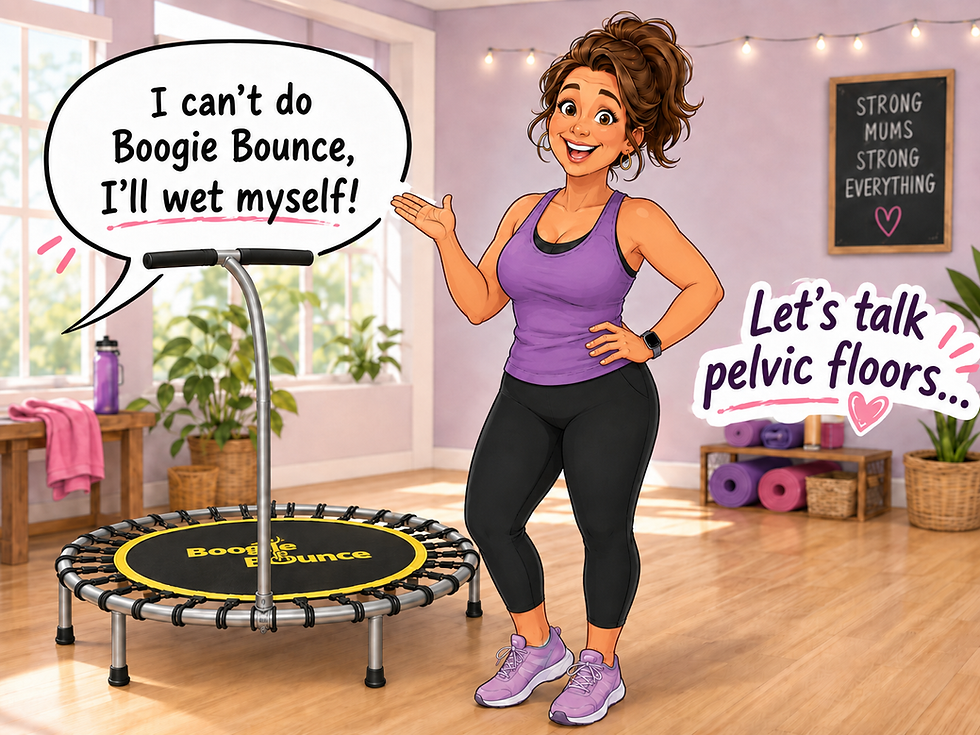
If I had a pound for every time someone said to me, “I can’t do Boogie Bounce, I’ll wet myself,” I would not be writing this blog.
I would be writing it from a sun lounger in the Maldives, sipping something fancy with a tiny umbrella in it, living my best pelvic-floor-funded life.
But honestly, I hear it all the time.
And I get it.
I really do.
Bladder leaks, pelvic floor weakness, sneezing accidents, laughing-too-hard moments, coughing and thinking, “Oh no, we’ve got movement” .... it is all very real. It is also far more common than people think. But here is the bit I want to say with my whole chest:
Leaking is common, but that does not mean you have to just accept it as your forever normal.
Now, before anyone comes for me with a Tena Lady in one hand and rage in the other, let me be very clear. I am not saying everyone’s situation is the same. I am not saying one class will magically cure incontinence. I am not saying prolapse, menopause, childbirth, surgery, age, hormones, or medical conditions are not real factors.
They absolutely are.
What I am saying is this:
Your body can improve. Your pelvic floor can get stronger. Your confidence can come back. But you have to start somewhere.
And yes, that somewhere might include going to the toilet three times in one class and wearing a pad.
Glamorous? No.
Normal? Absolutely.
Worth it? One hundred percent.
What Is the Pelvic Floor?
Your pelvic floor is a group of muscles that sits at the bottom of your pelvis. Think of it like a supportive hammock.
Not the holiday kind where you lie there with a cocktail.
More like the “holding up your bladder, bowel, uterus, and all the important bits” kind.
Your pelvic floor helps with:
Bladder control
Bowel control
Core support
Posture
Breathing
Sexual function
Supporting your pelvic organs
Basically, it is doing a lot of work in the background while receiving very little appreciation. A bit like most mums, really.
When the pelvic floor muscles become weak, stretched, tense, uncoordinated, or under too much pressure, bladder leaks can happen. This is especially common with jumping, coughing, sneezing, laughing, running, lifting, or high-impact exercise.
And yes, bouncing.
Why Do Bladder Leaks Happen During Exercise?
A lot of people who say, “I’ll wet myself if I jump,” are talking about stress incontinence.
Stress incontinence is when urine leaks because pressure is placed on the bladder. This can happen when you:
Jump
Bounce
Run
Cough
Sneeze
Laugh
Lift something heavy
Do high-impact exercise
It does not mean you are lazy.
It does not mean you are broken.
It does not mean your fitness days are over.
It usually means your pelvic floor is not managing pressure as well as it could.
Pregnancy, childbirth, perimenopause, menopause, age, constipation, chronic coughing, weight changes, heavy lifting, and years of high-impact movement can all play a part.
So if your bladder has ever betrayed you mid-star jump, please know this:
You are not the only one.
You are just part of a very large club that nobody asked to join.

I Know What It Feels Like
I have been teaching Boogie Bounce for 11 years. I have two children. Both were born naturally.
So when someone says to me, “You don’t understand, I’ve had kids,” I promise you, I do.
After I had my daughter Brea, who is now six, I came back to class around six weeks after giving birth. She was born naturally and weighed around 6lb.
And let me tell you, my bladder was not exactly giving strong independent woman energy.
Before class, I went to the toilet.
Then I put a pad on.
Then I did the warm-up.
Then I had to go back to the toilet again.
Changed the pad.
Had another wee.
Went back in.
Did the next routine.
Needed the toilet again.
Had another wee.
But here is the interesting bit: the pad was dry.
After that, I went back in and finished the rest of the class, and I did not need the toilet again.
At the time, my body was still recovering. My bladder, pelvic floor, core, hormones, and nervous system were all trying to work out what on earth had just happened.
Birth is beautiful, yes. But it is also like your body has been through a full renovation and someone forgot to tell the pelvic floor team.
But that situation did not last forever.
It improved.
Why?
Because I worked on it. I trained. I listened to my body. I did my pelvic floor exercises. I rebuilt strength and control slowly.
Not in one week.
Not in one magical “do this one move and never leak again” way.
It took consistency.
Boring word. Powerful results.
Can Pelvic Floor Exercises Help Bladder Leaks?
Yes, pelvic floor exercises can help many people improve bladder control, especially when they are done correctly and consistently.
The key word there is consistently.
You cannot do three pelvic floor squeezes once while waiting for the kettle and then declare the whole thing a scam.
Your pelvic floor is made of muscle, and muscles need training.
A simple way to find your pelvic floor is to imagine you are trying to stop yourself passing wind and stop yourself having a wee at the same time. You should feel a gentle lift and squeeze inside.
Try not to:
Hold your breath
Clench your bum
Squeeze your thighs
Pull your tummy in aggressively
Panic like you are defusing a bomb
It should feel controlled, not frantic.
You need both short squeezes and longer holds. And just as importantly, you need to fully relax afterwards. A strong pelvic floor is not one that is gripping for dear life all day. It needs to know how to switch on and switch off.
Like a good ring light.

What About Men and Pelvic Floor Problems?
Pelvic floor issues are often talked about as a women’s problem, but men can have bladder leaks too.
Men can experience pelvic floor weakness, bladder control issues, bowel control issues, and leakage, especially with age, after prostate surgery, or if the pelvic floor muscles are not working well.
So no, bladder leakage is not just a “mum thing.”
It is a human body thing.
Women often talk about it more because pregnancy, birth, perimenopause, and menopause can all affect the pelvic floor. But men are not magically exempt.
They just tend to be quieter about it.
Shocking, I know.
“But I Have a Prolapse…”
This is where we need to be sensible.
If you have a prolapse, ongoing leakage, pain, heaviness, dragging, pressure, or symptoms that worry you, please speak to your GP or a pelvic health physiotherapist.
Exercise can be adapted, but you deserve proper support.
I have had women in class with real bladder issues. One woman told me she had a prolapsed bladder. She still leaked, and she knew she may always have some leakage because of her history and the strain her body had been under over the years.
But she also told me that coming to class helped her control the leakage better.
It did not reverse the prolapse.
It did not magically fix everything.
But it helped.
And sometimes, improvement is the win.
Sometimes feeling more in control is the win.
Sometimes walking into a class you were scared of is the win.

Can You Do Boogie Bounce If You Have Bladder Leaks?
This is the question, isn’t it?
Can you do Boogie Bounce if you are worried about leaking?
For many people, yes .... but you may need to start gently, take lower-impact options, and build up over time.
You do not have to go full kangaroo on day one.
You can keep the bounce smaller. You can march. You can step. You can reduce impact. You can focus on posture, breathing, and control.
You can also:
Go to the toilet before class
Wear a pad if it gives you confidence
Stand near the door if that helps
Take the low-impact option
Pause when needed
Build up gradually
Speak to your instructor if you feel comfortable
And please hear me when I say this:
Going to the toilet during class is not failure.
Wearing a pad is not failure.
Taking the lower option is not failure.
Starting again after having a baby, gaining weight, losing confidence, entering menopause, or not exercising for years is not failure.
That is starting.
And starting is where everything changes.
Your Body Can Improve Over Time
This is the bit I really want people to understand.
Your first class is not your forever class.
If you come to Boogie Bounce and need the toilet before class, after the warm-up, and halfway through, that does not mean it will always be that way.
It might simply mean that is your starting point.
Over weeks and months, your body can adapt. Your muscles can become stronger. Your coordination can improve. Your confidence can grow. Your bladder can feel less bossy.
Will everyone have the same results? No.
Will some people need specialist support? Yes.
Will some people still leak? Yes.
But can many people notice improvement with the right support and consistency?
Absolutely.
And this is why I get so passionate about it.
Because I do not want people ruling themselves out before they have even tried.
Please Do Not Let Fear Stop You
If you are avoiding exercise because you are scared you might leak, I understand.
But avoiding movement forever is not always the answer.
Confidence comes from evidence. Your brain needs proof that your body can cope. You build that proof by starting small and showing up.
You do not need to be perfect.
You do not need to bounce like a caffeinated gazelle.
You do not need to have a bladder of steel.
You just need to start where you are.
Pad on? Fine.
Toilet before class? Fine.
Low-impact option? Fine.
Little break halfway through? Fine.
You are still there. You are still moving. You are still doing something good for your body.
And honestly, everyone else is too busy trying to breathe, follow the moves, and work out which leg is left to be worrying about your bladder.
Frequently Asked Questions About Pelvic Floor Exercises and Exercise
Can pelvic floor exercises stop bladder leaks?
Pelvic floor exercises can help reduce bladder leaks for many people, especially when done correctly and consistently. However, results depend on the cause of the leakage. If symptoms are ongoing, painful, or getting worse, it is best to speak to a GP or pelvic health physiotherapist.
Is it normal to leak urine when jumping or bouncing?
It is common, but that does not mean it should be ignored. Leaking when jumping, bouncing, coughing, sneezing, or laughing can be a sign that your pelvic floor needs support.
Can I do Boogie Bounce if I have a weak pelvic floor?
Many people can still take part by using lower-impact options, reducing the bounce, taking breaks, and building up slowly. If you have prolapse symptoms, pain, pressure, heaviness, or significant leakage, get medical advice first.
Do men need pelvic floor exercises too?
Yes. Men have pelvic floor muscles too, and pelvic floor exercises can help with bladder and bowel control.
How long does it take to improve pelvic floor strength?
It varies from person to person. Some people notice changes within a few weeks, while others need several months of consistent practice and support.

Final Thought
Pelvic floor issues are common, but silence makes them feel shameful.
And I am not here for that.
We need to talk about bladder leaks, pelvic floor exercises, childbirth, menopause, and exercise without making people feel embarrassed.
Your body is not ruined.
Your bladder is not the boss of you.
And your pelvic floor is not beyond hope.
It takes time. It takes consistency. It takes patience. And yes, sometimes it takes a pad and a pre-class wee.
But you can improve.
You can get stronger.
You can feel more confident.
And you absolutely can start.
So if the only thing stopping you is, “I might wet myself,” please know this:
You are not alone.
You are not weird.
You are not broken.
And honestly, love, most of us have had a moment where our pelvic floor tried to hand in its notice.
Come anyway.
Start small.
Keep going.
Your future self .... and your bladder .... might just thank you for it.
Important note: This blog is for general information only and is not medical advice. If you have ongoing bladder leakage, pain, prolapse symptoms, pelvic heaviness, pressure, or sudden changes in bladder control, please speak to your GP or a pelvic health physiotherapist.

Comments